Palaces of the Crow by Ray Nayler
Palaces of the Crow by Ray Nayler
An appreciation
Ray Nayler’s Palaces of the Crow
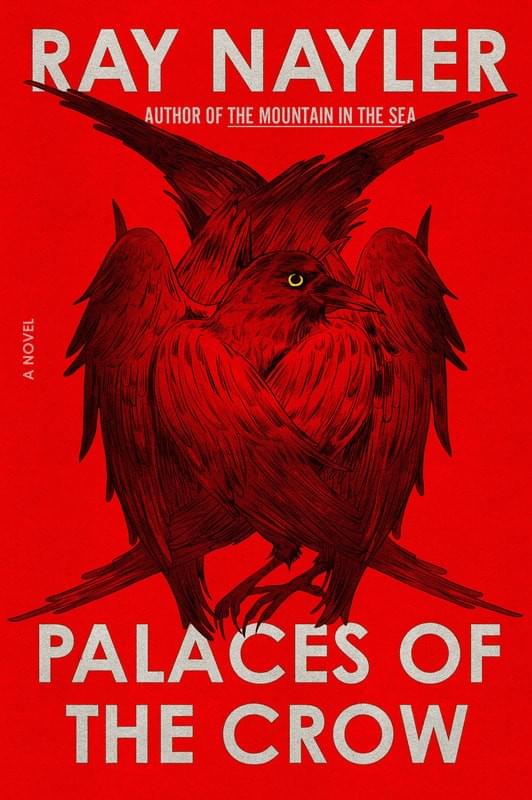
Spoilers. This is not a review, but an appreciation. Spoilers.
I liked Nayler’s first novel, The Mountain in the Sea, in no small part because it focused on animal consciousness and AI. It seemed, to me, preoccupied with the problems of an inevitable future that the author found too big to grapple with meaningfully. And that was the point.
It has been awhile since I read Mountain and I may be selling it short. It’s a fascinating book, well-worth your time. Palaces of the Crow, while not offering a pat solution to the problems of history and humanity, hints at a path forward where ‘greater’ intelligence is not the solution.
Palaces of the Crow takes many of the same predilections and themes of Mountain and eschews SF tropes, introducing the reader of 2026 (and beyond) to a landscape, people, and a history we believe we know. The reality of the WWII setting is more varied and less black and white than at least this U.S. reader understood.
The tale begins with a crow named Buster coaxing a young Jewish girl into the forest. It ends, on some level, with her and her memories of the city Vilnius where she grew up, its beauties, oddities, and profundities. Those memories are anchored by her parents who, despite poor treatment within the city, sought to help the wider community. The girl shared these memories with the other children, her companions during the war.
One of the boys is already a hunter and a soldier, and remains one on their behalf during these years. He feels, unlike the others who learned from him or taught each other languages and science, how to read, that he remained unchanged by the experience.
After the war he seeks revenge. But still later, he finds this pursuit futile, and decides it is preservation, returning the ‘kindness’ paid them by the crows, that is most worthy of him. A truth they all grapple with is the fact of the brutality each of them both experienced and committed during the conflict. The book does not suggest Utopian ideals as a solution to our history. Even the titular Palaces have instances of violence.
It might be that we cannot totally divorce ourselves or each other from this malady.
But…
Neriya, the Jewish girl of the group, is incredibly curious and intelligent. I thought this toward the beginning of the book, but I came to realize the greater point in how common the hungry, capable, young mind. Neriya benefited from her circumstance. Kezia, in contrast, came from a meager background, not merely uneducated but, she believes, doomed to a genetic heritage that will leave her in despair and madness. Throughout the book Neriya teaches Latin, Yiddish, Russian, reading and writing, and so much more.
The mute boy, younger than the others, brings them together and is both the cause of Kezia’s early salvation, and the recipient of something Kezia could not at that young age understand as her creation: a solid foundation, family. Love. The real, true deep love of companions who will remain true to each other without explanation or justification.
These children, carrying heritages of the best of humanity, and deficits in the worst—civilized each other. Sometimes simply through the fact of their need and dependence.
Mutual aid, the text suggests.
I’m not going to comment much on the crows. Someone’s going to read this despite the spoiler warning and I don’t want them to think they have the measure of the book. There’s so much more.
But this. This thought that I need to get out of me. This is a book about WW2, about children who never existed, and a hyper-intelligent group of corvids that aids those children.
It is a book that plays both with what happened, and what it means. By including chapters in the nineteen-seventies, we understand those years they spent with the crows through the character’s adult point of view, from the bliss of the 1971 Soviet bloc.
And it’s a book about the decline of democracy and freedom in the first quarter of the twenty-first century. It suggests, to this reader, that we will find in division and demarcations only strife, violence, and destruction. Those divisions may be political, religious, national, ethnic. It suggests, bereft of obligation to one’s fellow, education, literacy, language, art, responsible use of the world in which we exist, we risk becoming animals not merely seeking survival, but blinded with blood lust and this malady of violence.
There is another way. We can choose to justify jack-booted thugs in our streets, shooting civilians dead. Justify children in cages, men who in weeks before worked in a hair salons or agriculture in sunny California, now are in foreign prisons, disappeared forever. We choose if believing, or loving, or appearing different is the texture of society, or a malignancy to be destroyed.
We choose if we teach our children how to think or what to think, and if we equip them for a complicated world or if we train them to do as they are told.
In 2026, I know people who ‘talk to Claude’ or ‘talk to Chat.’ As an SF writer, if would be nice if this meant they conversed with artificial minds, autonomous and self-directed. That is not the case. Instead, they supply mega-corporations with data that will, ultimately, not be used to their favor. Many of us spend hours per day, caught in various algorithms and social platforms. We don’t speak to or know our neighbors, we belong to no social groups, we have no third spaces in which we linger.
Palaces is a rich book, and I’m commenting on a sliver of it here. There is a lesson for people living through a slow, boring apocalypse in these four kids living through a harsh and violent one.
We are the answer.
No one of us can save the world, but we can choose to be responsible, to take up for our others, lighten their load or ensure they have food to eat, to teach what we know—because you know something vital others need—or to be honest in our needs. Because someone among us has something vital to share. Because we need to be needed.
This, Palaces suggests to me, is the great work on offer for us, if we choose to live as sentient beings and refuse mere predation and profit. We can create something greater than war or economics. We can create community.
It may be that soon, minds greater than ours go to war with each other. To the extent that we can build communities based on mutual aid amongst our human enclaves, we may hold out hope to guide those minds to come.
Palaces of the Crow is a fantastic book: I hope you’ll spread the word.
Brandon
